
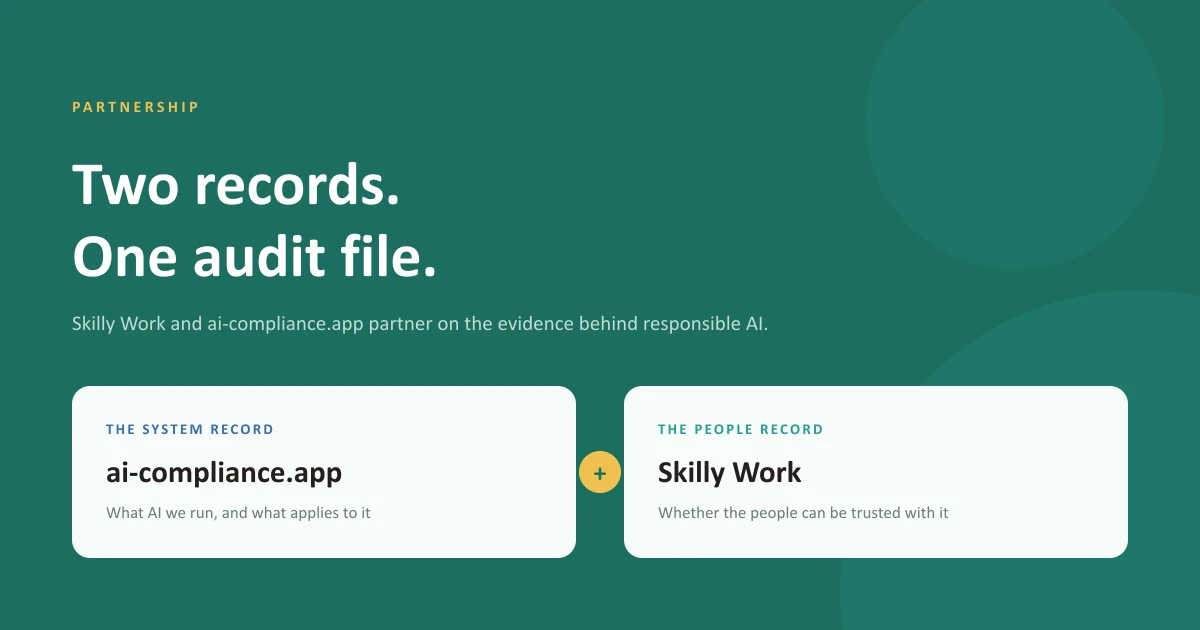
Skilly Work and ai-compliance.app partner to close the evidence gap between AI governance and human judgement
Skillscan Ltd and Tipcan Solutions Ltd have agreed a co-selling and co-marketing partnership. One platform records the AI systems an organisation runs. The other evidences whether the people named in that record apply the controls in real work.
The Skilly Team
Skillscan Ltd, the company behind Skilly Work, and Tipcan Solutions Ltd, the company behind ai-compliance.app, have agreed a co-selling and co-marketing partnership to help organisations build a complete, defensible evidence base for responsible AI.
AI has moved from experiment to everyday work. Governance frameworks, registers, policies and training have followed. The next challenge is evidence.
When a board, regulator, insurer, client or procurement team asks how AI is governed, an organisation must answer two different questions:
- Are our AI systems properly governed?
- Are our people applying those controls when they use AI in real work?
That distinction sits at the heart of this partnership.
ai-compliance.app: the system layer
A structured system of record for AI governance: an AI system register, risk classification, regulatory mapping, ISO/IEC 42001-aligned management-system support, an AI Bill of Materials and disclosure support for transparency requirements.
Two things set it apart from the enterprise governance platforms. It generates the actual disclosure wording an organisation needs to publish, rather than telling it that some is required. And it cuts the same record into separate exports for a regulator, an insurer, a procurement reviewer and a public trust page, because those four readers each want something different.
It answers: what AI are we using, what obligations apply, who is accountable, and what evidence have we retained?
Skilly Work: the people layer
Recurring evidence of how people approach AI-assisted work. Employees complete short, structured cycles based on real AI-use situations, assessed against Skilly Work's behavioural framework, Consider, expressed through five observable habits: Scrutinise. Hold the decision. Acknowledge. Ring-fence. Practise. Each habit is assessed on a four-level rubric, producing a repeated, consented, per-person evidence trail rather than a single completion certificate. People with formal oversight duties sit in a separate tier and are reported as their own group, because they carry the responsibility the regulation names.
It answers: how are our people actually using AI, where is judgement strong or weak, and what evidence can we show of that over time?
Why now
The EU AI Act emphasises AI literacy, transparency, and human oversight (Articles 4, 26 and 50). This partnership helps organisations navigate these evolving regulations by providing clear, actionable evidence, reducing compliance uncertainty and building stakeholder confidence.
Organisations increasingly need evidence not only of the controls they have designed, but of the people expected to make those controls work.
How the partnership works
- Reciprocal referrals. Where one platform identifies a gap better addressed by the other, customers are introduced directly to the relevant team.
- Joint engagement with compliance, risk, governance, operations and learning leaders, to build system-level and people-level evidence side by side.
- Joint market education. Through webinars, articles and practical guidance, we aim to help leaders stay at the front of AI governance and workforce readiness.
The two products remain commercially and operationally independent: contracted, priced and supported separately. Customers can adopt either one or both. Neither replaces training, certification or existing governance programmes. The partnership is designed to strengthen those investments.
What this means if you are already a customer
Rest assured, your current contracts, pricing and support remain unchanged, ensuring ongoing stability without disruption. No customer data passes between the two systems, and each company remains the data controller for its own product.
How progress is measured
The system layer is measured by coverage. How many AI tools in use are registered, how many have a completed risk classification, how many name a person responsible for oversight, and whether the applicable disclosure obligations have been met.
The people layer is measured by participation and by movement. How many people completed the cycle, where the group sits across the four levels for each habit, and whether that distribution shifts from one cycle to the next.
The measure neither platform can produce on its own is the one worth watching: the proportion of registered AI systems whose named oversight owner also holds a current evidence record. The system record supplies the names. The people record shows whether the names mean anything.
"AI governance ultimately has to work through people"
Shane Maguire, Founder and CEO of Skillscan Ltd, said:
"AI governance has two evidence problems. The first is understanding and governing the systems an organisation uses. The second is knowing whether the people using those systems are exercising the judgement the governance framework expects.
A register can tell you what AI exists, what controls apply and who carries responsibility. But sooner or later every control reaches the human workforce. That is where Skilly Work begins.
This partnership gives organisations a clear, reliable view from AI systems to human oversight, fostering confidence in responsible AI practices."
Alan Thornton of Tipcan Solutions Ltd said:
"Good AI governance cannot end with a policy, a register or the assignment of responsibility. Organisations also need confidence that the people carrying those responsibilities can exercise them effectively.
ai-compliance.app provides the structured governance record around the AI system. Skilly Work adds an evidence layer around the people using and overseeing it. Together, that is a more connected and defensible picture of responsible AI."
Govern the system. Develop the people. Evidence both.
Request a joint walkthrough at skilly.ie or ai-compliance.app.
Regulatory references are provided as context and do not constitute legal advice.
See how your people actually use AI.
Try the interactive Skilly Work demo, or talk to us about running a pilot with your team.