The board is accountable for AI now. What's in your evidence file?
Regulators from Dublin to Doha have placed accountability for AI outcomes with boards and senior management. Most organisations can show a training completion report. That's a thin file. Here's what evidence of actual AI judgement looks like, and how to build it.
The Skilly Team
Imagine the review meeting after an AI-assisted decision goes wrong. A credit file priced off a figure the model invented. A shortlist nobody checked for bias. Client data pasted into a free tool.
The board asks for the evidence file. In most organisations it contains three things: a training completion report, a signed AI policy, an attendance list.
Every one of those proves that people were told. None of them proves the thing the board is accountable for: that people exercise judgement when they use AI on a Tuesday afternoon with a deadline.
The accountability question has already been answered
This isn't where regulation is heading. It has arrived, on three fronts at once.
- UK. The FCA won't write an AI rulebook. Under SM&CR, AI-shaped outcomes belong to named senior managers.
- EU. The AI Act asks employers to ensure AI literacy in the people using AI on their behalf, and DORA requires the management body itself to hold the knowledge and skills to assess the risk. Not delegate it. Hold it.
- Gulf. The Central Bank of the UAE puts governance and accountability first among its responsible-AI principles. The Qatar Central Bank goes furthest: the board is accountable for the outcomes of AI systems, a human oversight protocol is mandatory, and an AI register is disclosed to the regulator annually.
Different jurisdictions, one direction of travel: accountability for how AI is used now sits with the people who govern the organisation.
Provision is not competence
Organisations are not ignoring this. The world's biggest banks have put tens of thousands of employees through AI training. But look at what all that activity produces as evidence: completion records, quiz scores, policy attestations.
A completion certificate proves someone finished a course. It says nothing about their judgement under pressure. The gap between "knows the right answer in a quiz" and "does the right thing at 4pm on a deadline" is exactly where the risk lives, and it is invisible to a read-receipt.
That's the gap in the file. Not a training gap. An evidence gap.
What evidence of judgement looks like
Here's a real workplace reflection, two sentences long:
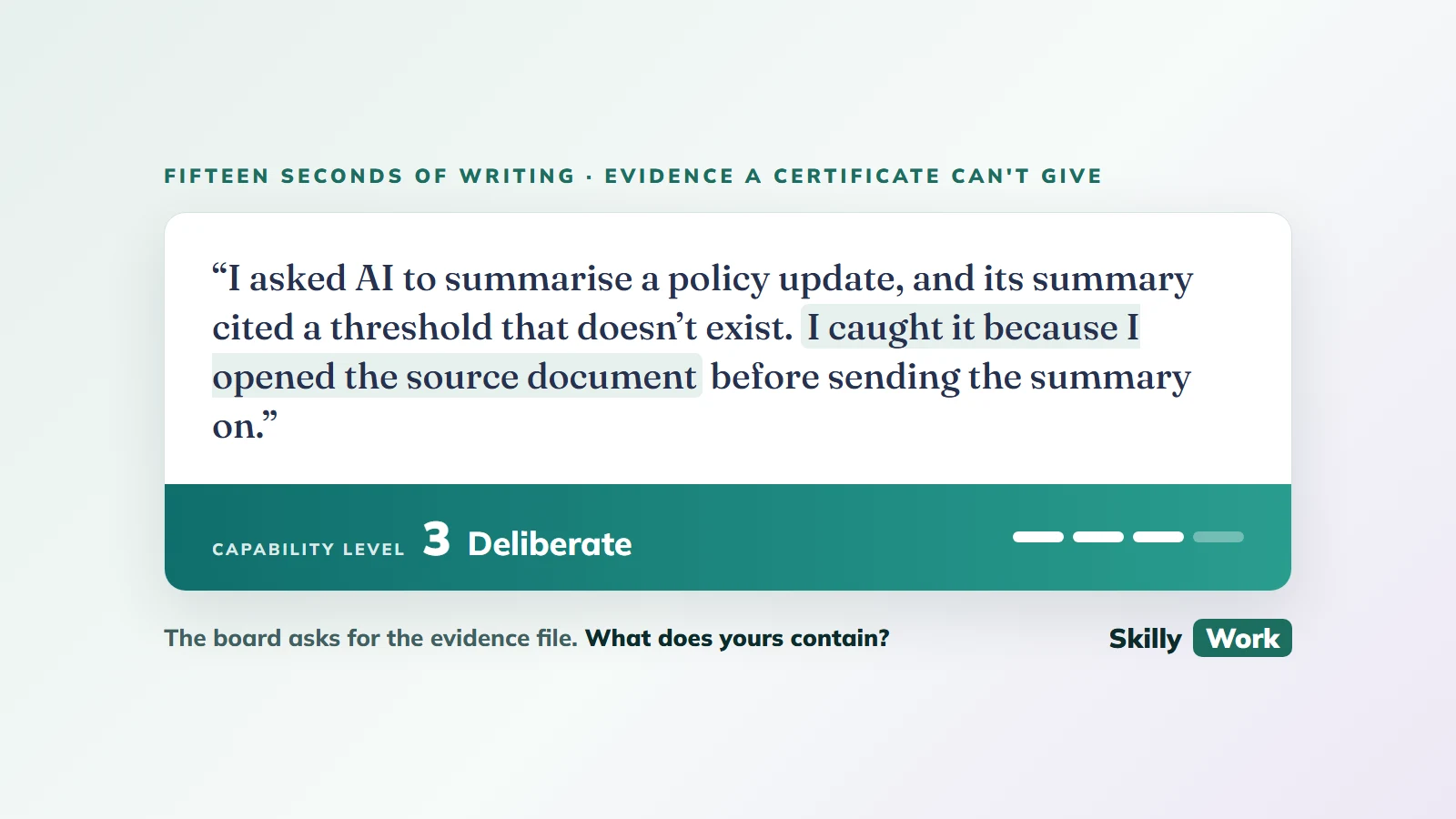
"I asked AI to summarise a policy update, and its summary cited a threshold that doesn't exist. I caught it because I opened the source document before sending the summary on."
Fifteen seconds of writing. Skilly Work scores it Deliberate, level 3 of 4: a repeatable habit, applied on purpose, with the judgement explained. The employee gets a short coaching note. The organisation gets a line in a record no completion report can offer.
Run that quarterly across every enrolled employee, scored against five observable habits (Scrutinise, Hold the decision, Acknowledge, Ring-fence, Practise), and you accumulate a timestamped, per-person record of applied judgement, with risk patterns surfaced to managers as they appear. When a supervisor, a client or a board asks how your people actually use AI, that record is the answer.
Three questions for your next board meeting
- What's in our AI evidence file today? If the answer is completion records and a signed policy, you hold proof that people were told, nothing more.
- Could we evidence the judgement of the people overseeing AI decisions? Oversight is now a named duty in every framework above.
- If a regulator asked for one person's record, what would it contain? Accountability is converging on the person. The evidence should too.
The organisations that will answer comfortably in a year's time are the ones that start building the record now. It takes about fifteen minutes per person per quarter, alongside whatever training you already run.
See the scoring engine work in under a minute, no sign-up needed, at skilly.ie/demo/work. Type a real AI moment from your own week and see what it scores.
Learn more about how your institution can develop, and evidence, the right behaviours to govern AI use in your organisation at skilly.ie/work.
See how your people actually use AI.
Try the interactive Skilly Work demo, or talk to us about running a pilot with your team.